
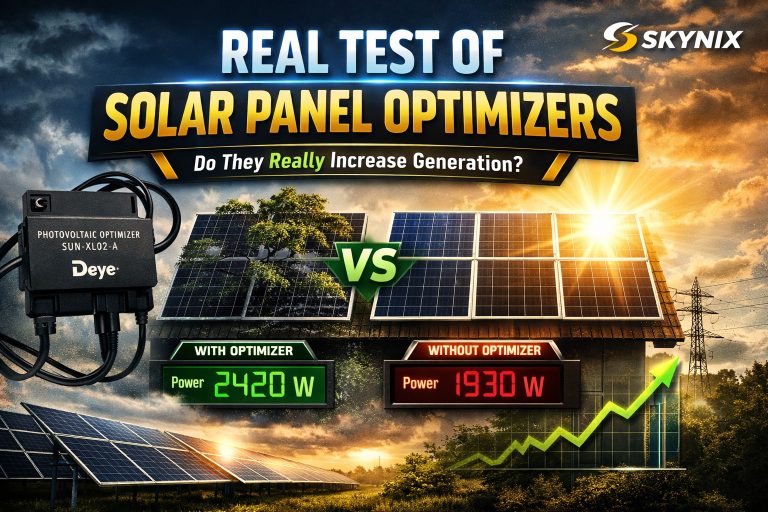
Solar panel optimizers are often marketed as a way to increase energy production and reduce losses caused by shading. Manufacturers promise smarter panel control and improved efficiency.
But how much difference do they actually make in real installations?
To find out, the Skynix team conducted a practical test on a working solar system, measuring voltage, current, and generation under different conditions.
No simulations.
Only real measurements.
💡What We Tested
During the test, we evaluated several important parameters of the solar system:
• change in total generation power
• MPPT inverter behavior during operation
• system performance under partial shading
• the difference between operation with and without optimizers
This allowed us to see when optimizers truly improve system performance and when their effect is minimal.
💡Why Optimizers Exist
In a traditional solar string, panels are connected in series. If one panel becomes shaded or produces less power, it can reduce the output of the entire string.
Optimizers are designed to prevent this.
They allow each panel to operate closer to its own optimal point, adjusting voltage and current so the inverter can still receive the best possible power.
In theory, this means less energy loss when conditions are not ideal.
💡When Optimizers Can Make a Difference
Based on real installations and our test results, optimizers provide the biggest benefit in systems with non-uniform conditions.
- Uneven Sunlight. If panels receive different levels of sunlight because of roof shape or nearby objects, optimizers can help balance production.
- Partial Shading. Trees, chimneys, antennas, or nearby buildings can shade panels during part of the day. Optimizers help reduce the negative impact of a shaded panel on the entire string.
- Different Panel Orientation. If some panels face east and others west, their peak generation happens at different times. Optimizers help each panel work more efficiently in such layouts.
- Different Panel Models. If panels of different power ratings are used in one string, optimizers can reduce mismatch losses.
💡When Optimizers May Not Be Necessary
In systems with ideal installation conditions:
• no shading
• identical panels
• the same orientation
• correct system design
modern inverters with MPPT controllers already work very efficiently.
In these situations, the difference between systems with and without optimizers may be very small.
📌Optimizer Used in the Test
For the experiment we used the Deye smart photovoltaic optimizer.
Deye SUN-XL02-A Smart Optimizer
This device is designed to improve performance in solar systems with shading or complex panel layouts.
More details about the optimizer:
https://skynix-solar.com.ua/fotoelektrichnij-rozumnij-optimizator-sun-xl02-a-deye.html
✅ Key Findings
After testing the system under real conditions, several conclusions became clear:
✔ optimizers can improve generation when shading is present
✔ under ideal conditions the increase may be small
✔ the payback depends on the specific system configuration
This means optimizers should not be installed blindly — their effectiveness depends heavily on real installation conditions.
Solar optimizers can be a useful tool for improving photovoltaic system efficiency, especially in installations where conditions are not perfect.
They are most effective when:
• shading occurs during the day
• panels have different orientations
• different panel models are used in the same string
Before installing optimizers, it is always best to analyze the real operating conditions of your solar power system.
A well-designed solar installation often performs very efficiently even without additional electronics.