
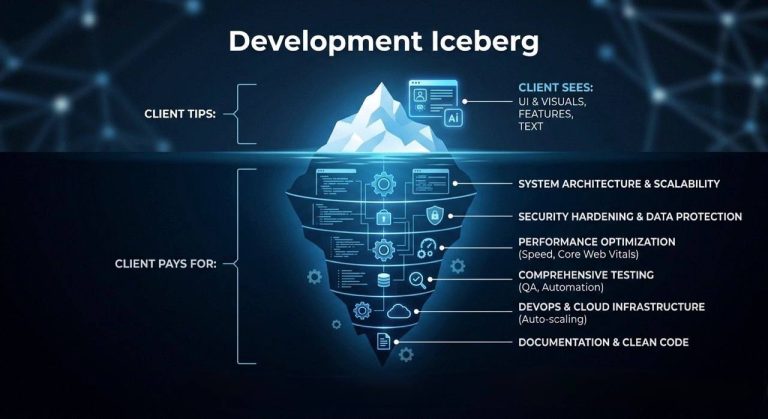
Why does a software project estimate often feel like an iceberg? 🧐
Because as a business owner or product manager, you usually see only the visible part above the water:
- 📎 “Just add a ‘Buy Now’ button.”
- 📎 “Just update this checkout step.”
- 📎 “Just connect one more third-party integration.”
Sounds simple and fast, right? But under that tiny word “just,” there is a massive block of hidden logic quietly floating beneath the surface.
Let’s dive deep into why project estimation in software development is so tricky, what is hidden underwater, and how we can make your next project quote actually realistic.
What’s Hidden Beneath the “Simple Button”?
When a developer looks at a “simple change,” they aren’t just looking at the visual element. They are mapping out the entire ecosystem behind it.
What you see on the surface:
- A “Simple” Button
What is hidden underwater:
- Payment Gateway Logic
- Real-Time Stock Validation
- Multi-Level User Roles
- Legacy Code Dependencies
From our experience, a single new feature can trigger a chain reaction across your entire backend architecture. For instance, that “simple button” might need to interact with:
- Complex business workflows: Checking inventory levels, calculating custom taxes based on user location, and firing automated emails.
- API limitations: Third-party services (like CRMs or payment processors) have rate limits or specific data formats that require custom middleware.
- Legacy code quirks: If the original site architecture is a bit outdated, adding something new might break an existing setup.
4 Reasons Why Software Estimates Shift During Development
If software development estimation is done by experienced engineers, why do timelines still sometimes change? It’s not because someone is bad at math. It’s because code is a living organism.
1. The Interaction Effect
Small issues love to stay hidden at the beginning. They only wave hello when the new change starts interacting with your existing code setup.
2. Shifting Requirements
As the project moves forward, the business flow becomes clearer. Once everyone sees how a feature works in real life, it’s completely natural to say: “Wait, now that I see it, we actually need it to do X instead of Y.”
3. Edge Cases
What happens if a user clicks the button twice? What if their internet drops mid-payment? What if they try to apply a promo code that expired one minute ago? Handling these “what ifs” is what takes 80% of the development time.
4. Hidden Technical Debt
Sometimes, before we can build a shiny new room (feature), we first need to reinforce the crumbling foundation (refactor old code) left by previous developers.
How to Get a Realistic Project Estimate
We still don’t have a crystal ball in our office (though we check Amazon for one regularly). However, we have found a few practical ways to make software project estimation incredibly accurate:
🚀 Never Skip the Discovery Phase
A proper discovery phase is the best insurance against unexpected costs. It’s where developers, project managers, and business stakeholders map out every user flow, edge case, and tech stack limitation before a single line of code is written.
🗣 Clear and Honest Communication
If a feature sounds suspiciously simple but carries high architectural risks, a reliable development agency will tell you upfront. Transparency beats a “pleasing but unrealistic” estimate every single time.
📐 Embrace Reasonable Flexibility
Agile frameworks exist for a reason. Budgeting a small buffer (typically 15-20%) for unforeseen technical challenges or scope adjustments keeps the project moving smoothly without stressful contract renegotiations.
The Verdict: The Real Work is Under the Surface
At the end of the day, a good estimate is not just about counting hours for the tasks we can see. It is a small door into checkout logic, payments, inventory, permissions, analytics, and performance risks.
In software development, the real value is created when engineers anticipate what’s underwater and build a solution that won’t capsize your business ship.
Thinking about scaling your platform or adding a complex integration? We love diving deep into backend architecture and untangling legacy code. Drop us a line in the chat box below, and let’s map out a realistic roadmap for your project!