
Choosing between these two approaches isn’t just a technical decision—it’s a choice about how your business will make money tomorrow. A mistake at the start can lead to blowing your entire budget on “under-the-hood polish” instead of shipping new features for your users.
What is a Monolith and Why It’s Your Startup’s Best Friend
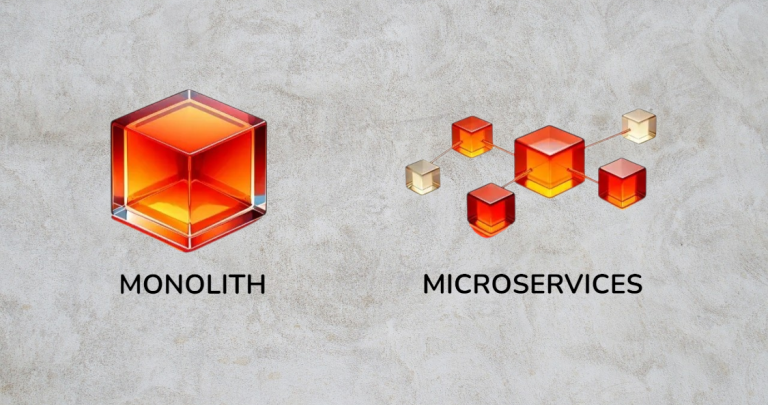
A monolithic architecture is a development model where your entire service functionality is combined into a single, unified codebase. Think of it like a single engine: if you want to add a feature, you plug it straight into that same core mechanism.
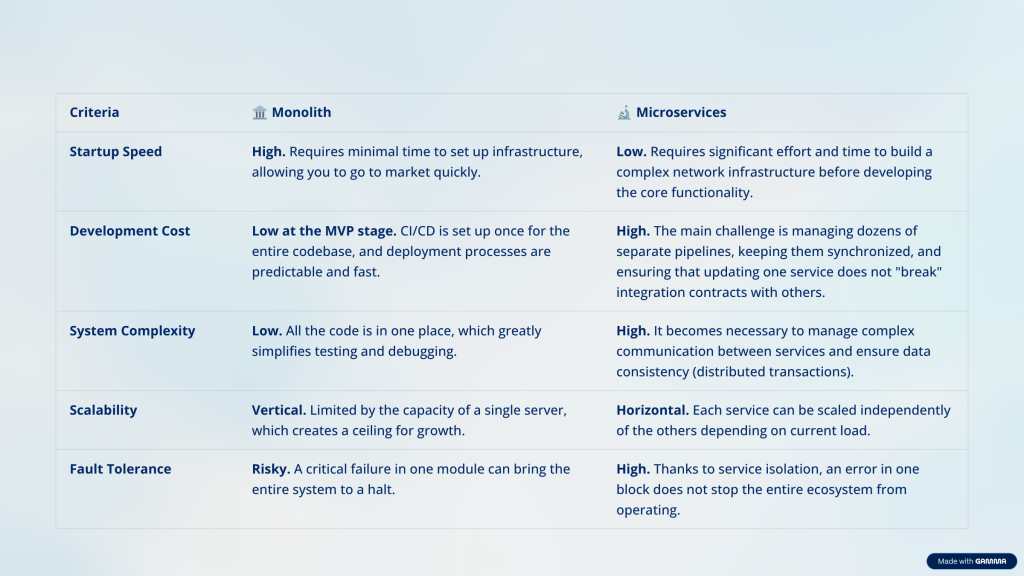
- Why it pays off: You get a fast time-to-market because developers don’t waste time configuring complex network links between system components.
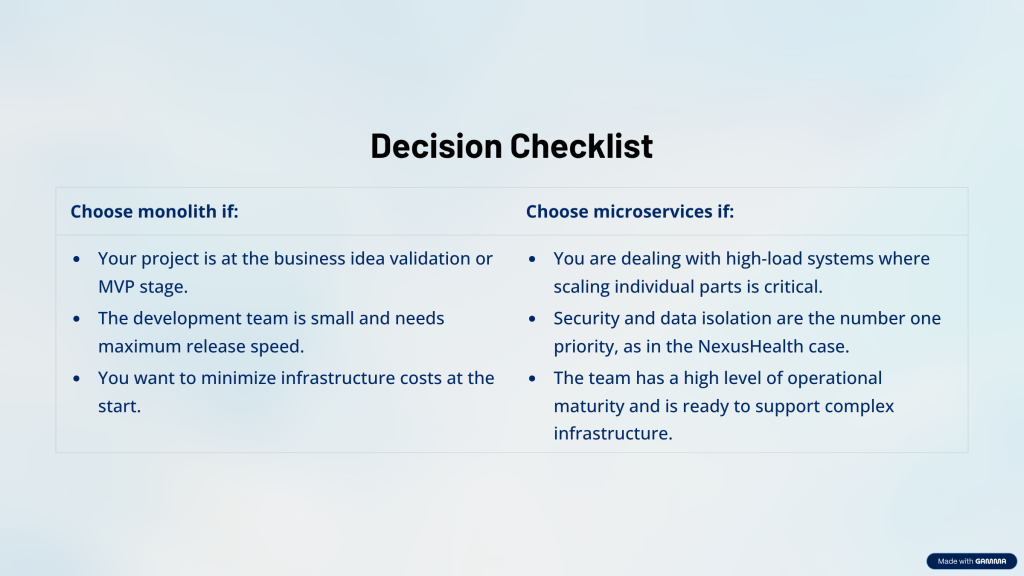
- When to choose it: A monolith is the ideal choice for an MVP (minimum viable product) or startup where the primary goal is to validate a hypothesis, acquire early users, and reach profitability.
- Business advantage: Cheaper maintenance, simpler testing, and faster releases for early product versions.
What Are Microservices and When Do They Become a Goldmine
A microservices architecture is an approach where your system is broken down into small, independent “building blocks” (services) that communicate with each other over a network. Each service handles a narrow task—for instance, one handles the shopping cart, another handles checkout, and a third manages logistics.
- Why it rocks: You get targeted microservices scalability. If you experience a massive surge on the checkout cart during Black Friday, you scale only that specific service instead of the entire website.
- When to choose it: Only transition to microservices when your business outgrows the monolith. This becomes necessary when your development team expands to the point where engineers start stepping on each other’s toes working in the same codebase.
- Business advantage: Enhanced system resilience—if the reviews service goes down, users can still purchase products and complete their payments seamlessly.
Fatal Mistakes: How Not to “Kill” Your Business with Premature Scaling
The biggest blunder a founder can make is prematurely migrating to microservices without a genuine need, often driven purely by technology hype.
- Why it’s dangerous: Microservices introduce massive overhead costs for DevOps infrastructure, continuous monitoring, and security management.
- The Risk: You end up with a “distributed monolith”—a system where every service drags, and troubleshooting the entire chain is ten times harder than fixing a single unified app.
- Your Strategy: Opt for a modular monolith. It’s the foundational architecture that lets you write clean code by separating logic into modules while keeping them inside a single deployment until real traffic metrics prove it’s time to split.
How It Looks in Practice: A Real Healthcare Case Study
Imagine building a healthcare platform where the cost of a mistake is patient data security and 24/7 system availability. Skynix implemented a robust microservices architecture for NexusHealth, dividing 13 distinct services (authentication, medical records, live chat, payment processing) into isolated blocks.
Why Microservices Won This Case:
- Targeted Scaling Without Overkill: When a hospital needs fast access to electronic health records (EHR) and a patient needs the chat feature, the system doesn’t lag because these services operate independently. We scale specific nodes, not the entire server.
- Strict Data Isolation: In healthcare, compliance mandates maximum data protection. Microservices architecture, combined with network isolation, separated the medical metrics database into a secure segment away from the public network. Even if a messaging service is compromised, patient data remains locked behind Private Link security.
- Independent Deployments: We update the payment gateway or AI API without halting medication reminder notifications.
NexusHealth Architectural Breakdown:
- Infrastructure: Docker and Nginx host networking drastically reduced network latency compared to standard Docker bridge mode, bringing performance close to bare-metal servers.
- Networking: Replacing the public internet with VNet Peering and Private Link acts like building a private underground highway where data bypasses public internet routes entirely.
Summary: Is Your Business Ready for This Level?
This case study proves that software architecture is a core competitive advantage. If you are planning a project where:
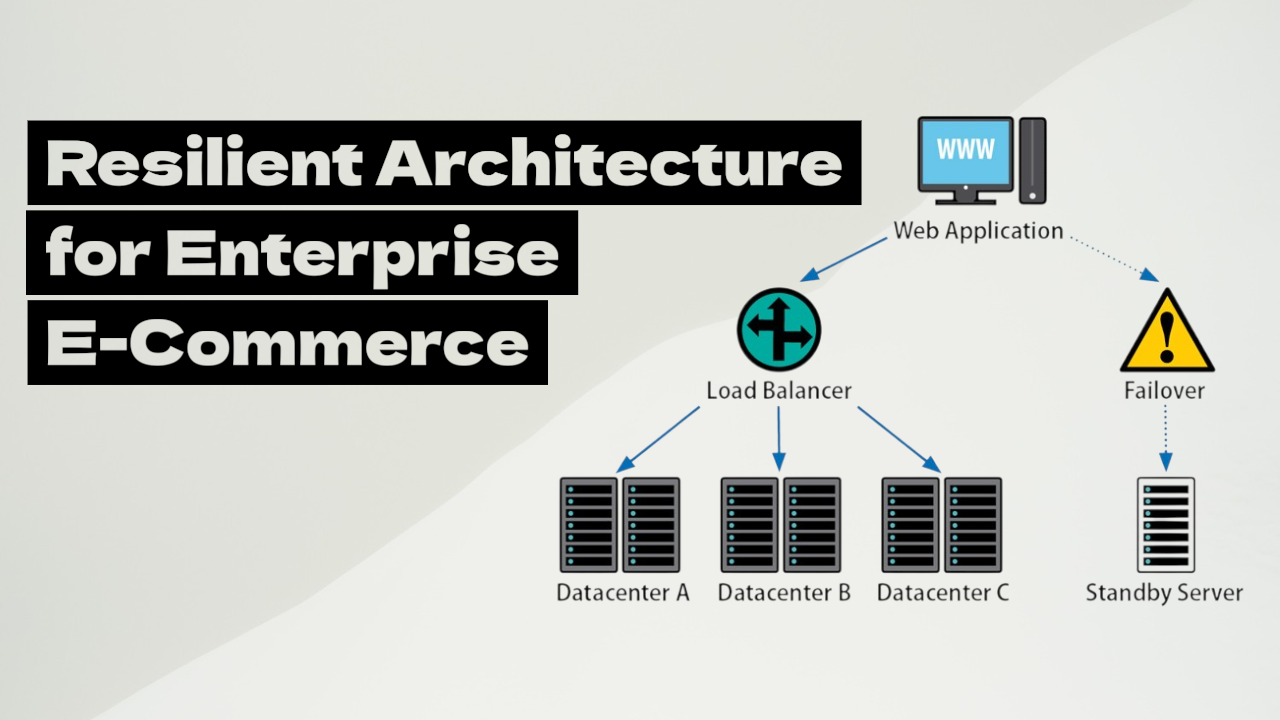
- Data security is mission-critical (Healthcare software development, Fintech solutions, enterprise E-commerce).
- User volume and user roles (patient/doctor/admin) are scaling rapidly.
- The system must maintain high performance under peak loads.
Then microservices are your path forward. But if you are at the product launch stage where every dollar must go into marketing and core user features, start with a modular monolith.
The golden rule: First, build a business model that demands scaling; then, build the system architecture to support it. Don’t build a spaceship to sell coffee on Instagram. That will be your first and most expensive scaling mistake.
Architecture is Your Business Foundation
The NexusHealth case clearly illustrates that choosing the right architecture balances speed-to-market today with scalability tomorrow. There is no one-size-fits-all solution: a monolith grants essential agility at launch, while microservices development becomes a tool for market dominance as traffic and security requirements grow.
Explore our professional software development services to help build and scale your custom project, drop us a message via our chat-bot or reach out on LinkedIn. We are always ready to discuss the optimal engineering strategy for your business.