
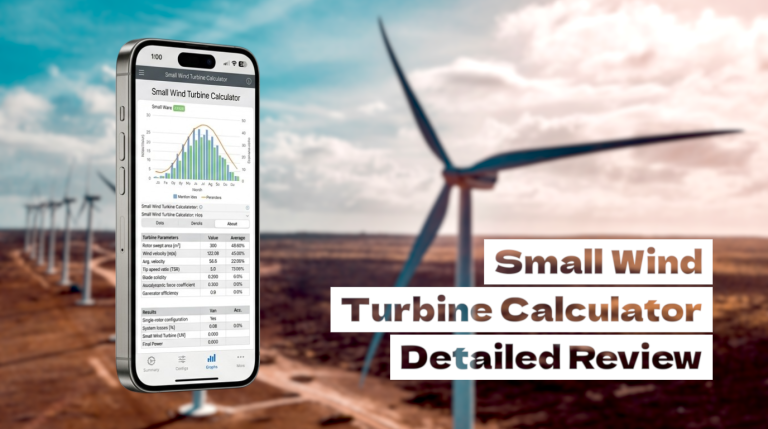
In our previous article on mobile wind turbine capacity calculation, we showcased the initial concept of our tool. We promised not to leave the project as-is, but to keep evolving it based on real-world feedback and community requests. Time to show what we’ve built!
Watch the Update in Action: Live Smartphone Test
Instead of a thousand words, it’s better to see the interface in action. Bohdan from our team recorded a detailed video review of the updated Small Wind Turbine Calculator on YouTube. Directly from his smartphone screen, he demonstrates how to set up a project, detect turbulence, and calculate real-world energy output in just a few seconds.
So if you prefer visual walkthroughs, tune into the video, while below we’ve rounded up the key technical insights.
Three Tiers: From First Test to Engineering Projects
The main headline of this release is the introduction of a free wind turbine calculator app tier. Now anyone can test out our wind generator calculator without entering credit card details or signing up for mandatory subscriptions.
Overall, the app offers three tiers:
- Free: Allows you to calculate one turbine and pull location data, but includes ads (helping us cover server costs and ongoing development).
- Ad-Free: For just $0.99/month, you get a clean interface without distracting banners.
- Premium: A complete engineering suite featuring multi-turbine comparisons (up to 10 turbines), aerodynamic customization, and PDF report export.
We also added an essential hemisphere toggle (Northern/Southern). Why? Because summer in North America is winter in Australia, and wind generation seasonality fluctuates significantly throughout the year. Now your off-grid power generation is calculated with your exact geography in mind.
NASA Integration: How the App Evaluates Local Wind Speeds
You don’t need to walk around your property with an anemometer or search through complex meteorological charts. The app performs wind power output calculation using NASA satellite data spanning the last 10 years.
Simply allow the app to fetch your location via GPS or manually paste coordinates from Google Maps. The application automatically pulls average wind speed metrics for your precise location at two key hub heights: 33 feet (10 meters) and 164 feet (50 meters).
Why a “Smarter” Wind Turbine Doesn’t Always Produce More Energy
Many people assume that a residential wind turbine with a variable pitch system is inherently superior to a simple fixed pitch unit. That’s not always the case!
Our small wind turbine calculator app accounts for real-world aerodynamics. In residential units, blade pitch rotation is usually mechanical (centrifugal). Its primary purpose is storm protection—over-speed protection—not maximizing kilowatt-hours.
When wind speeds exceed ~15 mph (7 m/s), mechanical pitch twists the blades to shed load, reducing efficiency. When running a wind energy production calculation, keep in mind that mechanical variable pitch under high winds often underperforms compared to a standard fixed pitch turbine. Active electronic variable pitch systems that boost efficiency are typically reserved for large commercial turbines on 60+ foot towers.
Turbulence, Trees, and Obstructions
By default, the tool sets system losses to 12%, representing ideal conditions with smooth, laminar airflow.
However, if your small wind power system is mounted on a typical 20-foot (7 m) tower in a backyard near houses, garages, or tall trees, you won’t get smooth airflow. Air movement will be dominated by turbulence.
In these scenarios, we recommend increasing the system losses setting in the app to 30%. While expected generation figures will drop, you’ll get realistic estimates rather than overly optimistic projections.
Multi-Turbine Comparisons and PDF Reporting
For installers, engineers, or DIY enthusiasts looking for granular detail, Premium unlocks two essential features:
- Multi-Turbine Comparison by Tower Height: Add up to 3 identical turbines at different hub heights (e.g., 40 ft, 50 ft, and 60 ft). The app plots a single comparative graph showing whether investing in a taller tower pays off.
- PDF Report Export: Generate a professional export with full data tables, monthly energy output charts, and system parameters ready to send to clients or save for your records.
Try It Out and Share Your Feedback!
We believe renewable energy calculation should be clear and reliable before you invest in hardware. Download our wind turbine calculator for iOS here and wind turbine calculator for Android here, test your local coordinates, and connect with us on LinkedIn to let us know what features you’d like to see next!