
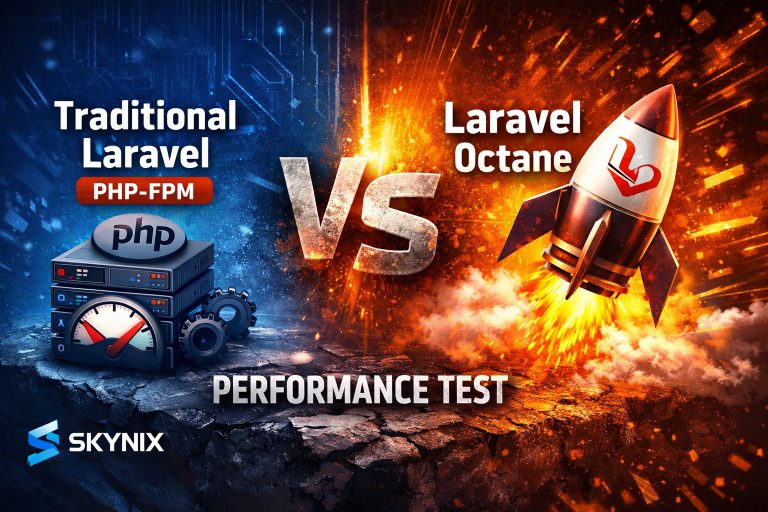
Laravel is one of the most popular PHP frameworks, but its performance often depends on how the application is executed. Traditionally, Laravel runs on PHP-FPM, where each request boots the entire framework from scratch.
But with Laravel Octane, the framework stays in memory and handles requests using long-running workers.
To understand the real difference, we ran a practical performance test comparing both approaches.
The goal of the test was to simulate a typical production scenario with moderate load.
Environment:
- 1000 total HTTP requests
- 50 concurrent users
- Same Laravel application
- Same server environment
- Same Cloudflare + TLS configuration
- Response payload size: ~48 KB
The only difference was the runtime engine:
- Traditional Laravel running on PHP-FPM
- Laravel Octane using long-running workers
The test was executed using ApacheBench (ab).
Benchmark Results 📊
The difference between the two configurations turned out to be dramatic.
Requests per Second
Traditional Laravel (PHP-FPM):
10.58 requests/sec
Laravel Octane:
97.06 requests/sec
🚀 Performance improvement: ~817%
Octane processed almost 9× more requests per second.
Average Response Time
Traditional PHP-FPM:
4.7 seconds
Laravel Octane:
0.5 seconds
⚡ Response time improved by ~84%
Octane dramatically reduced the time required to process each request.
Total Test Duration
Traditional PHP-FPM:
94.5 seconds
Laravel Octane:
10.3 seconds
⏱ ~89% faster completion
The entire benchmark finished nearly 9× faster with Octane.
95th Percentile Response Time
This metric shows the response time under load for most users.
Traditional PHP-FPM:
5.8 seconds
Laravel Octane:
0.58 seconds
📉 ~90% reduction
This means that 95% of users received responses in under 0.58 seconds with Octane.
🔑Why Laravel Octane Is Faster
The performance improvement comes from the way requests are handled.
Traditional PHP-FPM Model
For every request:
- PHP starts
- Laravel framework boots
- Service providers load
- Application handles the request
- PHP process ends
This process repeats for every single request, which adds overhead.
Laravel Octane Model
With Octane:
- Laravel boots once
- The application remains in memory
- Workers process multiple requests
- No full framework reload per request
This reduces overhead dramatically.
Octane uses high-performance servers such as:
- Swoole
- RoadRunner
These servers allow PHP applications to behave more like Node.js or Go servers.
🔑When Octane Makes the Biggest Difference
Octane provides the greatest benefit for:
- APIs with high traffic
- real-time applications
- microservices
- applications with heavy framework bootstrapping
- queues and background processing
In these scenarios, the reduction in boot time becomes critical.
🔑When PHP-FPM May Still Be Enough
Despite the performance gains, PHP-FPM still works perfectly for many projects.
It is often sufficient for:
- small to medium websites
- CMS-style applications
- low-traffic services
- hosting environments where Octane is not supported
PHP-FPM also has a simpler operational model, which can make deployment easier.
🔑Things to Consider Before Using Octane
Laravel Octane introduces a different runtime model.
Because the application stays in memory:
- some packages may not be fully compatible
- developers must avoid storing request-specific state globally
- memory leaks must be monitored
This means that code quality and architecture become more important.
Our test shows that Laravel Octane can deliver massive performance gains compared to traditional PHP-FPM.
In this benchmark:
- Requests/sec increased by 817%
- Response time dropped by 84%
- Test completion was 89% faster
For modern Laravel applications with significant traffic, Octane can transform performance and scalability.
However, it also introduces a different runtime model that requires careful development practices.
In short:
PHP-FPM is stable and universal.
Laravel Octane unlocks the next level of performance.